
There were crows.
And, for the record, they ate my bagel.
I was sitting on my back patio one morning, coffee in hand, writing about the alchemical concept of the nigredo (Latin for “blackness,” the darkest phase of transformation) when I heard a commotion behind me. I turned to find two crows waging full battle over what was supposed to be my breakfast.
I had to laugh.
Because sometimes the universe sends you the lesson in the most literal possible way.
What Is the Dark Night of the Soul?
Most of us know this experience without having a name for it.
It’s the season when you don’t recognize yourself in the mirror. When you go through the motions of your life and feel strangely absent from it. When the things that used to hold meaning feel hollow, and the version of you who “had it together” seems very far away.
In spiritual and psychological traditions, this is called the dark night of the soul. In alchemy, it’s called the nigredo: the blackening, the dissolution, the phase before transformation when everything that is false has to fall away.
And mothers? We know this intimately. We just rarely name it.
My Own Descent
It was March 2020.
My dad was in the hospital — immune-compromised from chemo — and I couldn’t reach him. My husband was working long hours. The world had shut down. And I was home with my children with no community, no support, no idea when any of it would end.
I remember standing in my kitchen one evening, kids finally asleep, feeling like I was dissolving.
The mother I thought I was. The daughter I’d always been. The woman who could hold it together. She was gone.
I didn’t have the language for it then. But I was in the nigredo. I was in my dark night.
Why We Pathologize What Is Actually Sacred
Here’s what I’ve learned through my own journey and from witnessing hundreds of mothers in circle: we’ve been conditioned to see our dark seasons as failure.
When we can’t hold it together, we think something is wrong with us.
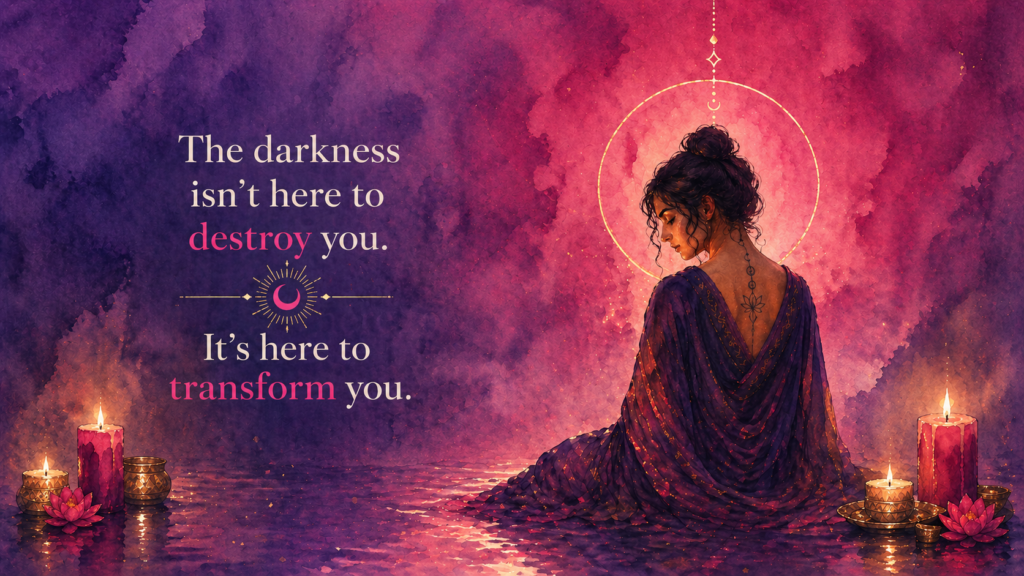
But depth psychologist James Hillman describes this experience as a necessary dissolution, a “deconstruction of positivity” that clears the ground for genuine paradigm shifts. The darkness isn’t punishing you. It’s composting the parts of you that were never truly you to begin with.
The mask of the perfect mother. The woman who needs nothing. The selfless caregiver who puts herself last.
These identities are real and they served you. But they were never the full you. And when they become too heavy to carry, the dark night arrives to help you set them down.
3 Myths About the Dark Night of the Soul (That Keep Mothers Stuck)
Myth 1: You’re in the darkness because something is wrong with you. The dark night of the soul isn’t a punishment. It doesn’t visit broken women — it visits women who are ready. Your darkness is a sign of your soul’s expansion, not your failure.
Myth 2: If you were more spiritual, more disciplined, or better at self-care, you wouldn’t be here. The nigredo comes for the devoted and the struggling alike. It has nothing to do with how much you meditate or whether you journal. It is, simply, your time.
Myth 3: You can hope your way out of it. This is the hardest one. The dark night asks us to surrender — not to despair, but to the process. Clinging to the old self only prolongs the dissolution. What’s being composted has to go.
The Light That Lives Inside the Darkness
Here’s what I didn’t expect when I stopped fighting the darkness: something shifted.
Not into brightness, not into certainty — but into a different kind of knowing.
I met parts of myself I’d never encountered: the woman who could sit with uncertainty without fixing it. The mother who could be vulnerable with her children instead of performing strength. The daughter who could love her father without trying to save him.
The mystics call it “the light that is darkness itself.” Not the absence of shadow, but illumination of a different quality entirely. The light of truth. Of authenticity. Of coming home to who you actually are.
An Invitation If You’re In It Right Now
If you’re reading this from inside your own dark night (whether it’s postpartum depression, a marriage shifting, the slow erosion of knowing who you are, or just a quiet, grinding emptiness you can’t name) I want you to know:
You’re not lost. You’re being found.
This is not a detour from your path. This is your path.
When you’re ready to come back to yourself — not the performing version, not the holding-it-together version, but you — start here: the Pressure Relief Kit is a free resource I made for exactly this moment. Simple tools to bring your nervous system back to ground when the darkness feels like too much.
A Simple Practice for the Dark Night
- Light a candle. Create a small space of intention.
- Place your hand on your heart.
- Ask gently: “What part of me is ready to be released so I can come home to myself?”
- Write down whatever surfaces — without judgment.
- Close with: “I trust this process. I am being transformed.”
The crows got my bagel that morning. And somehow the whole essay wrote itself.
Sometimes the universe knows what it’s doing.
If this resonated, you might love joining me and Indigenous psychologist Dr. Barbara Bain for a live dream work session on May 27th — where we’ll explore what your dreaming world has been trying to tell you. [Save your spot → Here]